
Do You Need An LLC For Your Therapy Practice?
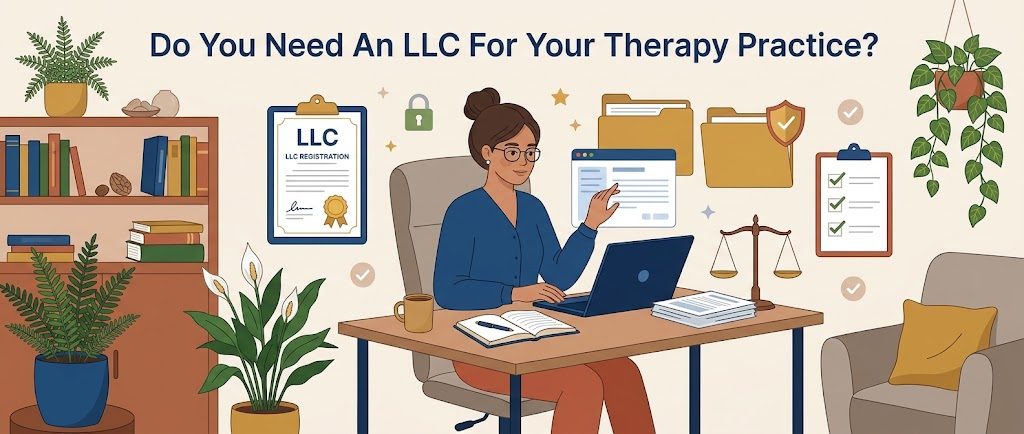
An LLC separates your business from your personal assets for many business risks, but it does not replace professional liability insurance, because you remain responsible for your own professional acts. Many solo therapists form one for liability, banking, and credibility. Check your state and licensing board, and ask a professional about your situation.
- An LLC separates your business from your personal assets for many business debts and claims, but it does not protect you from claims about your own clinical work.
- Professional liability insurance and an LLC do different jobs. Most practices need both.
- In Georgia the basic LLC route is straightforward and inexpensive compared with the confusion it can save you.
- A sole proprietorship is legal and simple, but it offers no separation between you and the business.
I have helped a lot of small businesses get organized, and the LLC question comes up in the first ten minutes every single time. It usually arrives in the tone of someone asking whether they are supposed to already know this.
You are not. Nobody is born knowing what a registered agent is. Here is the honest version, written for a solo therapist deciding how to set up a private practice.
What an LLC actually does
A limited liability company is a legal structure that exists separately from you. When it is run properly, with its own bank account, its own records, and decisions made in its name, it generally keeps the business's debts and many business claims separate from your home, your car, and your personal savings. That is the liability protection people mean when they say "get an LLC."
It also does a quieter set of jobs that matter just as much in practice:
- It gives you a clean line between business money and personal money, which makes bookkeeping and taxes easier.
- It lets you sign leases, software contracts, and vendor agreements in the practice's name.
- It looks like a real business to banks, landlords, and payers.
- It can make it easier to add partners, associates, or a second location later.
What an LLC does not do
An LLC protects you from the business's problems. It does not protect you from your own professional acts.
If a client alleges negligence in your clinical work, you remain personally responsible for your own professional conduct, with or without an LLC. That is the job of professional liability insurance, which is also called malpractice insurance. The two work together, and neither replaces the other.
An LLC also does not change your license obligations, your HIPAA duties, or your ethics code. And it does not automatically change your taxes. By default, a single member LLC is taxed like a sole proprietorship, which means you still pay self employment tax on your net profit.
Sole proprietor, LLC, PLLC, or S corporation?
| Option | What it is | Good fit when |
|---|---|---|
| Sole proprietorship | You and the business are legally the same. No filing required to start. | You want the lowest possible startup friction and accept personal exposure to business debts. |
| LLC | A separate legal entity, formed by filing with your state. | You want liability separation for business obligations and a more professional structure. |
| PLLC | A professional LLC, required or allowed in some states for licensed professions. | Your state or licensing board requires it for your profession. |
| S corporation election | A tax election, not a structure. An LLC can elect S corp tax treatment. | Your net profit is high enough that payroll and tax savings outweigh the extra cost and complexity. Ask a CPA. |
The S corporation question deserves its own caution. It can reduce self employment taxes for some higher earning practices, but it adds payroll, reasonable salary rules, additional filings, and accounting costs. Many solo therapists are better served starting with a simple LLC and revisiting the S election with a CPA once their income is stable.
The Georgia version
In Georgia, you form an LLC by filing articles of organization with the Secretary of State, which you can do online. At the time of writing, the online filing fee is about $110 and the annual registration is about $60, due between January 1 and April 1 each year. Georgia also has a requirement to publish a notice of the filing in your county's legal organ, and the cost of that notice varies by county, so ask about it when you file. You will need a registered agent with a Georgia address, which can be you.
Fees and rules change, so confirm current amounts with the Georgia Secretary of State before you file. Whether Georgia requires a professional LLC for your license type is a question to confirm with the Secretary of State and your licensing board. Many mental health clinicians in Georgia use a standard LLC, but you should verify for your specific license.
How to set up an LLC the right way
- Choose a name that is available with the Secretary of State and does not mislead about your credentials or services. Check your board's advertising rules too.
- File your articles of organization and handle any publication requirement.
- Get an EIN from the IRS. It is free, so be wary of sites that charge for it.
- Write a simple operating agreement. Even a single member LLC benefits from one. It documents how the business runs and strengthens the separation.
- Open a business bank account and run every practice dollar through it.
- Update your insurance and records so your liability policy and your NPI reflect your practice name where appropriate.
- Put the annual registration on your calendar so the entity stays in good standing.
The mistakes that quietly undo the protection
- Commingling funds. Paying personal expenses from the business account, or business expenses from your personal card, weakens the separation.
- Forgetting the annual registration. Falling out of good standing can create problems for your entity.
- Treating the LLC as insurance. It is not. Carry your own professional liability policy.
- Signing personally. Sign contracts as the business, with your title, so it is clear who is bound.
You are not legally required to form an LLC to practice in most cases. But for a practice that will hold a lease, a payer contract, and client trust, the structure is usually worth the modest cost. If you are unsure, ask a Georgia attorney or CPA to look at your situation. That conversation costs less than most people expect.
Once your entity is set up, the rest of the setup gets simpler. Your bank account, your EIN, your insurance, and your website can all use the same business name, which makes everything look and feel professional from the first inquiry.
See how the roadmap handles it
Haven walks licensed therapists from "I think I want my own practice" to a first client, one clear step at a time. It is free to start and no card is needed.
See how the roadmap handles itCommon questions
Is an LLC the same as professional liability insurance?
No. An LLC can protect your personal assets from some business debts and claims. Professional liability insurance covers claims about your own clinical work. Most practices need both.
Do I need a PLLC instead of an LLC?
It depends on your state and license type. Some states require a professional entity for certain professions, and many do not for most mental health clinicians. Confirm with your state and your licensing board before you file.
How much does it cost to form an LLC in Georgia?
At the time of writing, the online filing fee is about $110 with an annual registration of about $60. County publication costs vary. Always confirm current amounts with the Georgia Secretary of State.
Can I run a therapy practice as a sole proprietor?
Yes, it is legal and simple. The tradeoff is that there is no legal separation between you and the business, so business debts and claims can reach your personal assets.
Does an LLC change how I pay taxes?
Not by default. A single member LLC is taxed like a sole proprietorship, so you still pay self employment tax on net profit. You can elect S corporation treatment later if a CPA says it makes sense.
Do I need an operating agreement for a one person LLC?
Georgia does not require you to file one, but having one is strongly recommended. It documents how the business runs and supports the separation between you and the entity.
Sources and further reading
Rules, fees, and deadlines change. Confirm anything that affects a decision with the office that publishes it.
Keep reading
 Getting Started
Starting A Practice In Another State? What Changes When You Cross The Line
Moving or expanding your therapy practice across state lines changes licensing, entity rules, taxes, and telehealth. Here is what to check state by state.
Hope Nicely, LPC · November 10, 2026 · 10 min read Money
Year End Money Moves For Your Practice
A practical year end checklist for private practice owners: taxes, books, retirement, equipment, fees, and planning, so January starts clean.
Anthony Brown · November 3, 2026 · 11 min read Getting Started
The Associate To Fully Licensed Runway: Getting Ready Before The Day Your License Arrives
If you are an associate working toward full licensure, you can prepare for private practice now. Here is a 12 month runway so you are ready when your license arrives.
Hope Nicely, LPC · October 20, 2026 · 10 min readHaven Practice Solutions provides education and business tools, not legal, tax, or clinical advice. Nothing here creates an attorney client, accountant client, or clinical relationship.